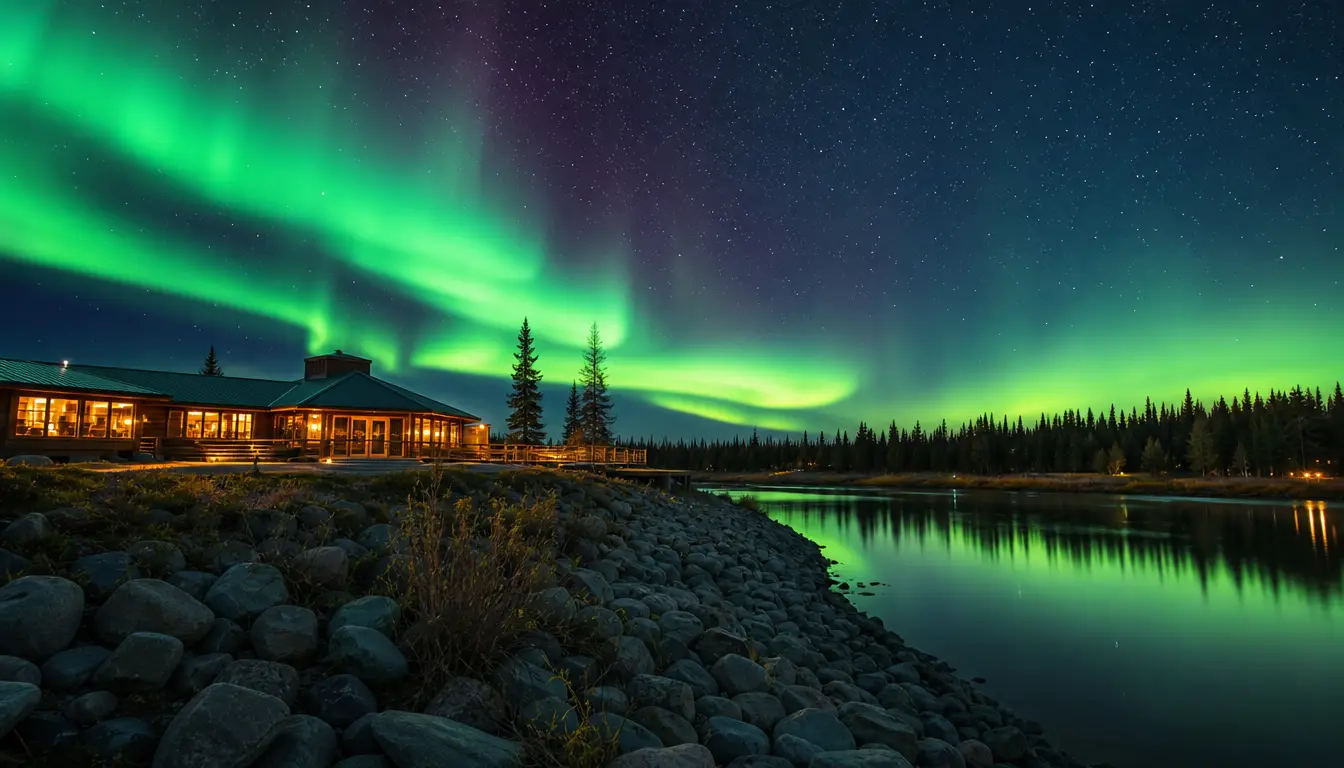
Fairbanks Northern Lights Forecast and Aurora Tracker
Standing outside in a turnout off the Steese Highway at 1:15 AM with ice crusted along the collar of your parka teaches you one thing fast: staring at a screen will not make the sky turn green. You refresh the app, look up at a milky patch near the constellation Cassiopeia, and wonder whether you are seeing auroral glow or thin cirrus clouds. Knowing how to read an accurate aurora forecast fairbanks travelers rely on changes the entire experience. It turns hours of freezing anticipation into targeted, well-timed night trips.
Most visitors arrive with an app installed that shouts alerts based on planetary averages. Then they sit in a warm hotel lobby waiting for an alarm that never rings, while twenty miles down the road the ribbon is already dancing across the ridgeline. Space weather does not behave like a standard rain forecast. To track the northern lights near Fairbanks, you have to understand solar wind, magnetic orientation, local topography, and the quirks of the auroral oval.
Book your fairbanks northern lights experience:
Understanding the Kp Index and What It Actually Means for Fairbanks
The Kp index is the first metric every beginner checks, and it is usually the one that misleads them most. Kp runs on a scale from 0 to 9, measuring geomagnetic disturbance across the entire globe over three-hour intervals. Tourist brochures love to warn you that you need a Kp 4 or Kp 5 storm to catch a show. If you were standing in Seattle, Minneapolis, or even Anchorage, that might be true.
Fairbanks is different. The city sits directly under the auroral oval at roughly 65 degrees north latitude. That placement makes it one of the most reliable viewing hubs on the planet. When the planetary Kp index reads 1 or 2 - levels considered dead quiet across North America - the sky above Goldstream Valley often erupts with vivid, sweeping green curtains. High Kp numbers matter only if you want the aurora to push far south toward the Midwest or Oregon.
A high Kp index can actually work against you here. During massive geomagnetic storms rating Kp 7 or Kp 8, the auroral oval expands and pushes southward. When that happens, the strongest bands of light often drop south of the Alaska Range toward Denali and the Mat-Su Valley, leaving Fairbanks looking back south at the display rather than directly overhead. Moderate numbers are usually where the sweetest local views hide.
| Kp Index | Fairbanks Sky Appearance | Denali & Southward Visibility | Activity Level |
|---|---|---|---|
| Kp 0 - 1 | Faint arc across northern horizon; occasional overhead bands | Rarely visible on horizon | Quiet |
| Kp 2 - 3 | Vibrant green bands directly overhead; dynamic movement | Visible low to moderate on northern horizon | Active local baseline |
| Kp 4 - 5 | Fast-moving ribbons, purples and pinks visible, whole sky covered | Bright curtains high in the northern sky | Minor to moderate storm |
| Kp 6+ | Explosive coronas overhead, shifting southward toward horizon | Directly overhead across Southcentral Alaska | Major geomagnetic storm |
The Best Aurora Trackers and Scientific Tools
The gold standard for local predictions has always been the Geophysical Institute at the University of Alaska Fairbanks. Founded back in 1946, the institute operates dedicated atmospheric observatories across the state. Their daily auroral tracker maps give an accurate projection of the oval's footprint over Alaska, breaking down visibility zones by regional coordinates.
Beyond the UAF daily charts, you need the real-time data collected by the Space Weather Prediction Center at NOAA. Three numbers determine what will happen over the next 45 minutes: solar wind speed, solar wind density, and the interplanetary magnetic field orientation, known to geophysicists as Bz. Speed tells you how fast the solar particles are travelling toward Earth. Normal baseline runs around 350 kilometers per second, but when an active stream pushes past 500 or 600 kilometers per second, displays become dramatically brighter.
Pro tip: Keep an eye on the Bz number on NOAA space weather charts. If Bz tilts sharply negative (southward) below -5 nT, Earth's magnetic shield opens up, and Fairbanks almost always gets an active display within an hour.
Bz orientation is the secret key. Think of Earth's magnetic field as pointing north. If the incoming solar wind's magnetic field points north too (positive Bz), the two fields deflect off each other like matching magnets. The energy slides right past. When Bz flips south (negative Bz), the fields link up, dumping tons of energetic charged particles directly down along the magnetic field lines right above your head. A quiet Kp 2 night with a sudden southward Bz drop of -8 nT will yield a brighter show than a Kp 5 night with a stubbornly positive Bz.
Several smartphone apps package this data cleanly. SpaceWeatherLive and the Glendale App pull directly from NOAA satellite relays. Instead of paying attention to the vague percentages that general weather apps spit out, watch the solar wind dials on these scientific tools.
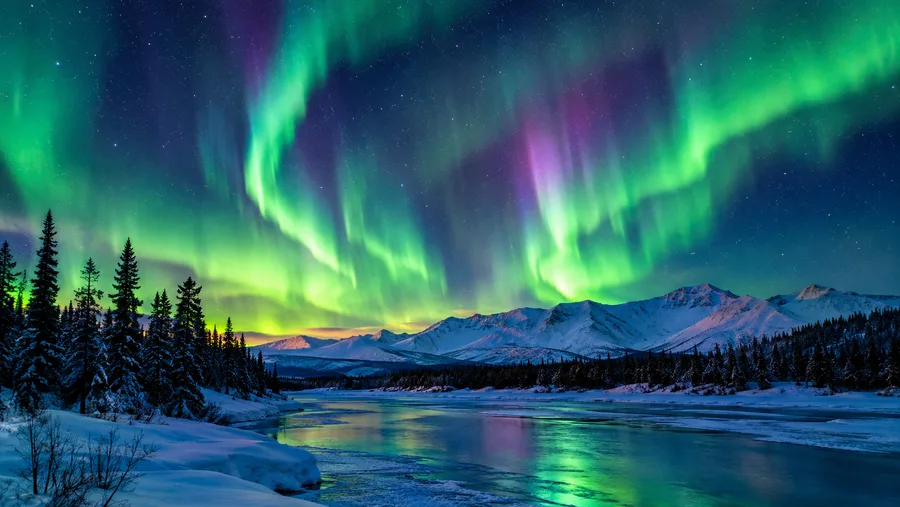
Cloud Cover vs Solar Activity: Why Weather Trumps Numbers
Space storms are useless if you are staring at a ceiling of low stratus. I have watched visitors sit inside cabins checking frantic notification feeds about severe space weather while thick, warm Pacific moisture draped fifty miles of gray cloud over downtown Fairbanks. The northern lights sit between 60 and 400 miles up in the ionosphere. Clouds hang between 1,000 and 25,000 feet. Weather down here always wins.
Tracking the cloud ceiling requires looking at microclimates. The Fairbanks basin holds cold, dense air in winter, which can trap ice fog under an inversion layer. When that happens, climbing 1,500 feet into the surrounding hills often pops you right out of the soup into bone-dry, crystal-clear skies. Exploring the best places to see the northern lights in Fairbanks will show you which ridge points sit above typical fog lines.
Note: Standard daytime weather forecasts often report clear skies when high, thin ice crystals still blanket the horizon. Check infrared satellite feeds from the National Weather Service Fairbanks office to spot high-altitude haze.
Wind direction matters tremendously. Southerly winds pushing up from the Gulf of Alaska tend to dump moisture against the south side of the Alaska Range, keeping Fairbanks dry via the rain shadow effect. Northwesterly flows can drag patchy cloud decks down from the Brooks Range. If the sky over the city looks murky, checking the local live feeds on Fairbanks northern lights live cams lets you peek at conditions out in Fox, Ester Dome, or Chena Hot Springs without burning a full tank of gas.
Moonlight is another factor people fret over unnecessarily. A full moon will wash out faint, misty aurora arcs, but once a true ribbon ignites, moonlight actually improves the view. It illuminates the snowy spruce trees, mountains, and foreground terrain, giving your eyes reference points and making wide-angle photographs look far more dramatic than shots taken against pitch-black ground.
Book your fairbanks northern lights experience:
How to Track the Aurora in Fairbanks Tonight
If you are planning to head out tonight, ditch the idea of driving aimlessly through back roads hoping for luck. Aurora hunting requires an organized evening routine based on changing observations.
- 4:00 PM - Regional Satellite Check: Open the National Weather Service Fairbanks satellite loop to watch incoming cloud decks. Look for clear slots along the Steese Highway corridor or south toward the Tanana Flats.
- 8:00 PM - Baseline Oval Verification: Look at the UAF Geophysical Institute map to see the predicted footprint of the oval. Check current solar wind speed; anything above 400 km/s gives you a solid platform.
- 10:00 PM - Ground-Truthing the Sky: Step outside away from porch lights. Give your eyes fifteen full minutes to adjust. If you see stars clearly overhead, your viewing platform is viable.
- 11:30 PM to 2:30 AM - Peak Window Monitoring: This is magnetic midnight in Fairbanks, the astronomical window when the auroral oval aligns most directly with your patch of sky. Keep your boots laced and gear packed.
- Post-Midnight - Real-Time Magnetometer Watch: Check the Poker Flat Research Range magnetometer graph. When the black trace line dips steeply downward, auroral substorms are actively discharging.
Patience plays the largest role. You can sit in a freezing car for three hours staring at what looks like a dull, gray band of smoke stretched across the northern horizon. Most people give up at this point, drive back to their hotel, and miss the display by fifteen minutes. That gray band is not a cloud; it is unexcited auroral plasma waiting for an energy pulse.
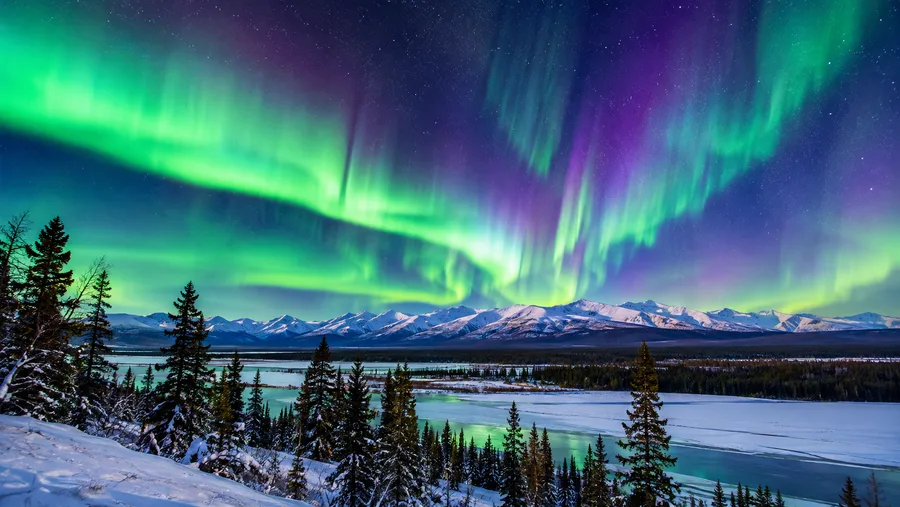
Reading Real-Time Space Weather Data Like a Local
When you spend enough nights waiting out substorms, you stop relying on general forecasts altogether. Instead, you look for tiny environmental hints that an eruption is building. The transition from a static arc to a chaotic, curling dance across the sky happens within seconds.
- The slow southward drift: A faint green ribbon that slowly creeps from the northern horizon toward the zenith indicates energy loading into the magnetotail.
- Beading along the bottom edge: If a smooth, static arc suddenly develops small wave-like ripples or curls along its lower boundary, a breakup is usually less than ten minutes away.
- Sudden purplish fringes: Nitrogen molecular ions glow deep violet and magenta under high-energy bombardment. When purple edges light up beneath the green curtain, the solar particles have penetrated deep into the atmosphere.
- A sharp drop in local magnetometers: Data from the Poker Flat station located just 30 miles north of town will show magnetic field lines bending violently right before an explosion of light.
After a big display blows apart into chaotic waves, it rarely ends completely. The sky usually breaks into what researchers call pulsating aurora. These look like irregular patches of green cloud blinking rhythmically on and off across the entire celestial dome, pulsing every five to fifteen seconds. Many people think the show is over because the distinct ribbons are gone, but lying down on the snow and watching the sky pulse like a heartbeat is easily the most surreal part of the night.
Frequently Asked Questions about aurora forecast fairbanks
Can you see the northern lights in Fairbanks tonight if the Kp index is only 1?
Yes, absolutely. Fairbanks is positioned directly under the auroral oval, meaning even quiet background solar conditions can produce bright, dynamic displays directly overhead without requiring an active geomagnetic storm.
What time of night is best to see the northern lights in Fairbanks?
The statistical peak occurs between 10:00 PM and 3:00 AM, with the highest concentration of intense activity centering around magnetic midnight, which occurs around 1:00 AM local time in interior Alaska.
How accurate is the University of Alaska Fairbanks aurora forecast?
The UAF forecast offers an excellent long-range look at general planetary activity, but local real-time observations - like NOAA solar wind speed and current cloud cover - are much more reliable for deciding whether to drive out on any given night.
Can I see the aurora if it is snowing or overcast in town?
You cannot see the lights through dense low clouds or falling snow. If Fairbanks is socked in, your best option is checking satellite loops and driving higher up onto local summits like Murphy Dome or Cleary Summit to get above the inversion layer.
Does a cold night mean the northern lights will be better?
Cold ground temperatures have nothing to do with the aurora, which occurs over 60 miles above the Earth. Cold nights often seem better simply because clear, cloudless high-pressure systems in an subarctic winter naturally drive surface temperatures far below zero.
Quick Reference
- Fairbanks sits at 64.8° N directly inside the auroral oval
- Kp 1-2 is often enough for brilliant local displays
- Peak viewing occurs between 11:00 PM and 2:30 AM
- Southward Bz (negative values) triggers the best activity
- Local cloud cover is a bigger factor than solar wind volume
Book your fairbanks northern lights experience:
Before You Head Out into the Cold
Checking the trackers is a useful habit, but don't let numbers keep you trapped indoors. Space weather data involves satellite relays floating roughly a million miles out at the L1 Lagrange point, giving scientists only a rough 45-minute warning before a solar wind stream strikes. Some of the most blinding coronas I have ever witnessed erupted on nights when every single app predicted completely flat, quiet conditions. Dress in heavy layers, fill an insulated thermos with something hot, find an open ridge away from town, and keep your eyes pointed up.
Read more about fairbanks northern lights.